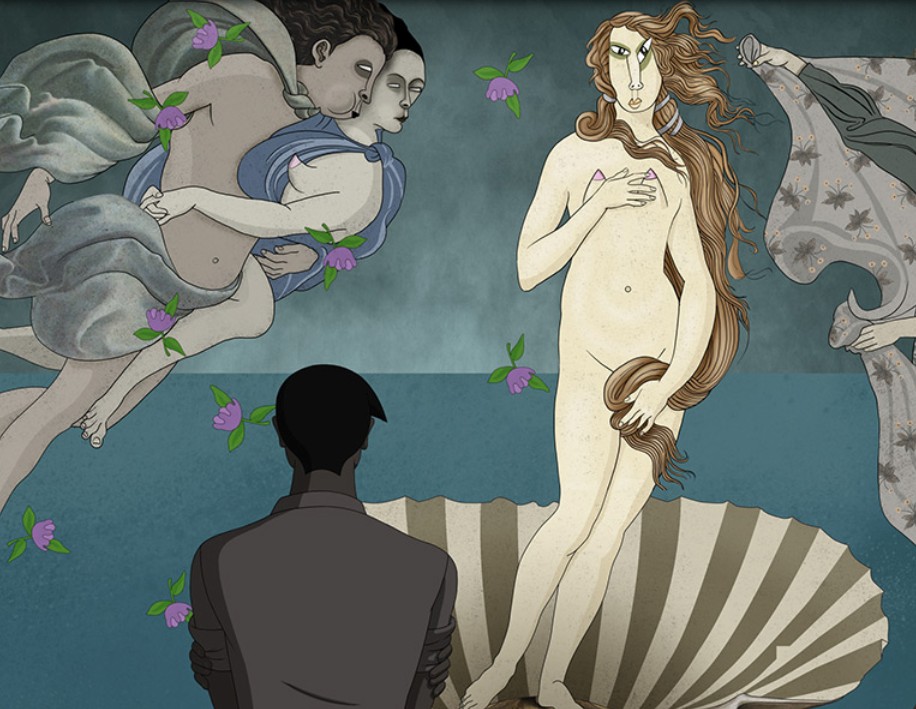
Sometimes to be creative, you have to give yourself permission to be weird. You have to give yourself that permission because no one else ever will. The movie Ruben Brandt, Collector takes that opening, runs through it, and carries you along on an hour-and-a-half train ride through a unique aesthetic.
Before I get started, I should note that I am not a fan of animation or anime. (That’s probably why the movie has been out since 2018 and I just found out about it.) I don’t have anything against animation; I simply prefer normally-shot films. So when I get excited about a movie that’s animated (and this one couldn’t have been done any other way), it means something.
First, the trailer. For me, movie trailers tend to fall into one of three major categories. The first is where basically all of the good parts are squeezed into two minutes or less, so when you actually watch the movie, it’s a disappointment. The second is when you watch the trailer then watch the movie, and you think, “Did the people who made that trailer even watch the movie?”
The third is when the movie is so good it can’t be squeezed into a trailer any shorter than the movie itself. Ruben Brandt, Collector falls into this category. There is a 90-second trailer which Hollywoodizes the movie to the point that it makes it look more clichéd and unoriginal than it really is. So if you insist on watching the trailer, watch it knowing that the actual movie is much better.
Here’s a synopsis from the press kit:
Ruben Brandt, a famous psychotherapist, is forced to steal 13 paintings from the world’s renowned museums and private collections to prevent his suffering from terrible nightmares he has as a result of subliminal messaging he received as a child. Accompanied by his four patients, he and his band of thieves strike regularly and with great success: the Louvre, Tate, Uffizi, Hermitage, the Museum of Modern Art. “The Collector” quickly becomes the most wanted criminal in the world, with gangsters and headhunters on his tail.
Plotwise, it’s not a particularly striking film. It’s a twist on the typical heist movie, but unlike the usual genre grind, it doesn’t concern itself with a big buildup to one huge operation where we’re biting our nails to see if they manage to pull it off. With twelve paintings to steal in a 93-minute movie, there isn’t time. The movie understands that, and it knows what it’s about. Nevertheless, it allows itself to play when the time comes for the twelfth and final theft. By then, success is inevitable. We know it and the movie knows we know it, so it gives us a hilarious action sequence that still leaves us satisfied even though we knew beyond a doubt that they were going to pull it off. That in itself is quite an achievement.
The plot is less important than the pervasive aesthetic that the director, Milorad Krstić, creates and sustains throughout. Here is what he has to say about it:
This film is built on two layers: the first one is an action-propelled heist story that a broader base of cinemagoers can relate to. The second layer presents a time surf over the waves of the 20th century’s art and movie world: from Caravaggio to Picasso, Eisenstein to Hitchcock, and from Elvis to Rocky, Ruben Brandt is a colorful blend of modern and classical pieces of art.

The art in this case manages to be not just the MacGuffin (which it is), but also the medium. Krstić says that this is the effect he was going for, and I say he succeeded:
I tried for a seamless encyclopedia of film and art, where every frame is full of well-known examples from the history of visual arts. Concerning my drawings in this film, I do hope that people will find them peculiar and imaginative. Building upon Godard, who said that photography is truth and the cinema is truth twenty-four times per second, I would say that for me drawing is imagination and animated film is imagination twenty-four times per second.
Here we get to the core of what Fiction Inspiration Fridays are all about. It’s not about inspiring you to write per se, but inspiring you to write in a new way, to try new things, to not write the same story a hundred times in a row. Often, the best way to do that is to step into another medium. That’s why I use photography, music (like in next week’s post), art, or even the intersection of art and music with album covers (like St. Etienne and The Nightfly).
Ruben Brandt, Collector (the title, by the way, combines two famous artists, Rubens and Rembrandt) dips you into an aesthetic like you’ve never seen before, and lets you swim around in it for an entertaining hour and a half. When you’re done, perhaps your brain and your pen will have a few drops of uniqueness infused into it.

I'd love to hear from you!