Last year, the New York Times had something they called the “10-Minute Challenge.” I came across it in September 2024 with the work “The Unicorn Rests in a Garden.” (It’s a gift link, so it should work even if you’re not a subscriber.) It’s as easy and as challenging as it sounds: take ten solid, continuous minutes looking at one work of art.
Now, I consider myself above average when it comes to looking at art. When going to the Cleveland Museum of Art, I frequently spend several minutes in front of one painting. I don’t try to rush through the whole museum in one trip; I’d rather spend a few hours in a section of the museum rather than sprint through the entire thing.
Even for me, though, about halfway through it became a real challenge. I started to wonder how much more there was to see in it. But a strange thing happened a minute or so later (about 6 minutes in): I started seeing lots of things in it one after the other. In a way, I spent the first half of the time looking at it, and the rest of the time seeing it. When the timer went off to announce it had been ten minutes, I still spent a few more minutes before proceeding to read the article about it which laid out several notable things that were there to see.
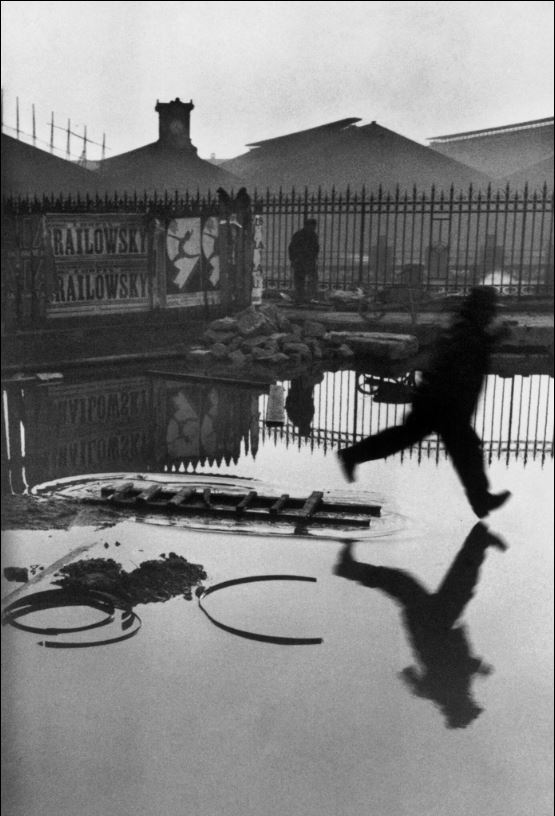
I thought the NYT’s article was a one-off experiment, but it turns out it was so unexpectedly popular that they run a new one on the first Monday of every month. I found this out when I saw another one, this one based on a well-known photograph from Henri Cartier-Bresson, one of the most famous pioneers in the art of photography. I highly recommend you try it out with this gift link.
If it isn’t working for you, here’s the picture:

Need some help getting started? I’ll give you the very beginning, then I’ll leave the rest of the joy of discovery to you. After all, it’s the things we find out for ourselves that we remember.
The first thing I usually do when I see any photo or painting is to look at the composition, especially the “rule of thirds.” (The rule of thirds is why your phone’s camera probably has an option to overlay a grid for you to help you line up a better shot.) Here’s what the partitioning looks like for this picture:

Now look at the middle third in this photograph, and near it, you see this:

That’s all I’m going to give you this week. The rest is your fun to have.
The reason it’s important for you to try this out for yourself is because if you want to write well, you need to do two things well: focus and notice. These two are critical because they operate in a self-feeding circle. When you focus on something, you notice things. When you notice things, you use focus to put it into your writing.
Next week, I’ll let you try your own 10-minute challenge with my favorite work in the entire Cleveland Museum of Art. I like it so much that I bought a reproduction of it on canvas. Until then, find ten or more uninterrupted minutes and sit down with Henri Cartier-Bresson. It will be ten minutes that will make an entire day of your life.

I'd love to hear from you!