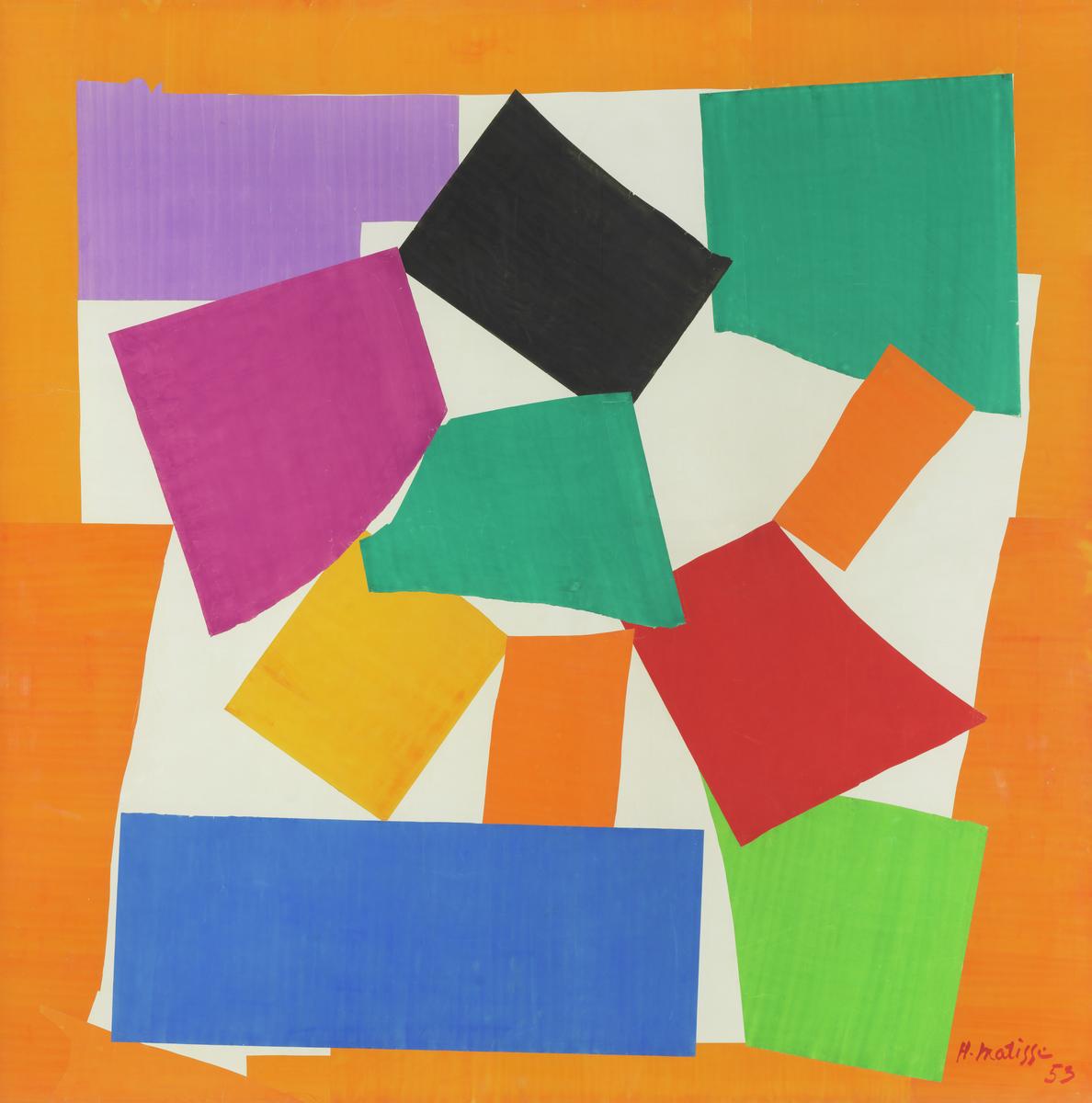
Does it seem like everything is stale nowadays? Movies, shows, and books all feel like they’re cut out of the same crust of week-old bread. Let’s get a fresh perspective by looking at a work that’s over seventy years old and was painted by someone who was even older than that when he did it, L’escargot (The Snail) by Henri Matisse:

There are so many things we could say about this that apply to writing, but let’s focus on just one: the color. In Techniques of the Modern Artists by Judith Collins, John Welchman, David Chandler, and David A. Anfam, we find this concise analysis:
Matisse’s palette was made up of nine colors which are held in position by a cadmium orange ‘frame’. Gouache, a dense type of watercolor, can produce an infinite range of color, yet he chose simple primaries: a cobalt blue, a deep red, and a warm cadmium yellow—and black and white—to which he linked five other complementary colors. Matisse controlled their strength with extraordinary precision. He said: ‘simple colors can act upon the inner feelings with all the more force because they are simple. A blue, for instance, accompanied by the shimmer of its complementaries, acts upon the feelings like a gong.’
We can see already why commercial fiction (for today, I’ll lump together movies, shows, and novels into “fiction”) feels so bland and uncreative. In an effort to drag the viewer or reader along the railroad track and never give them an opportunity to lose focus (in other words, pause, reflect, and digest), modern fiction limits itself to two colors: black and white. The clash of colors, which in fiction is the collision of ideas, is stripped into nothingness and replaced with inconsequential clashes via fight scenes and explosions.
What we end up is a less-talented version of this:

Instead of a vibrant dance of color and light and life, all we have left is incongruity. The thought and effort it took to place the colors exactly where they would affect the viewer the most by interacting with each other is gone. There is no longer a brilliant inverted arc of reds and orange swooping though the center and all we’re left with is modern fiction: a limp noodle of half-hearted shapes sagging in the middle.
As Matisse himself said,
It’s not enough to place colors, however beautiful, one beside the other; colors must also react on one another. Otherwise, you have cacophony.
I’ll emphasize this by closing with a superposition so you can see what happens when you let yourself use color and structure in your writing compared to when you don’t. Pay attention to the contrast here:

Next week, I’ll go to the other extreme and focus on the black square. Until then, don’t be afraid to let yourself use color. It will show in your work.

I’d love to hear from you!