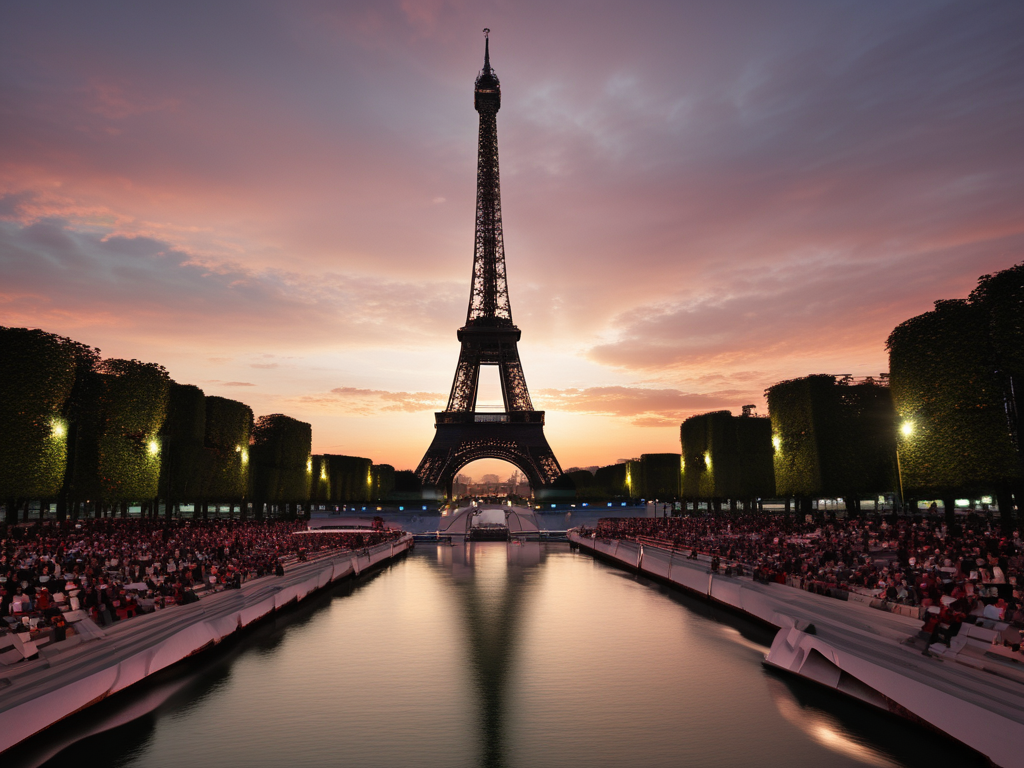
I had the good fortune to be off on the day of the opening ceremony of the Olympics in Paris this year. I’d heard a lot about the plans and I was looking forward to seeing how it would turn out, as French culture is so exuberant, creative, and daring. They’d shown their willingness to break the mold by taking the opening ceremonies out of the same old stadium venue and splashing it right down into the Seine, the current along which Paris floats.
It took courage to break with tradition and turn a formal ceremony into a city-wide street party. That courage was rewarded richly: the ceremony was one for the ages. It raised the bar for a performance that took place on a worldwide stage. Those who watched it—and I watched every single minute—will never forget it. Each opening ceremony has something special about it, one or two unique moments that are unforgettable. This year’s was a four-hour-long river of them.
It was brilliant, an absolute masterpiece of its kind, and that is always a problem for a certain segment of society. Always has been, always will be.
“Bizarre, incomprehensible.”
That may sound like some people’s description of this year’s opening ceremonies. It may be, actually; I wouldn’t know because I don’t listen to those people. I have 24 hours in each day and 60 minutes in each of those hours, and spending even one of them on those people is a price too high. Those kinds of people existed before I was born, they’ll be around long after I’m dead, and in between, I don’t have the time for them.
Bizarre and incomprehensible is the how the French Academy in Rome described Claude Debussy. Oui, even the French hate the French, right up until they make them part of the French canon. His music was played in the background during the opening ceremonies. Only the gravest sinners become the biggest saints.
As an author or an artist, creating a fictional world—perhaps better, perhaps worse, but certainly different—is not just what you do but what you have to do. With each new work, you create an alternate reality. Each work has its own rules within which it works. It’s a self-contained universe nestled into our own, but the power of it is that the little nugget of beauty inside can bleed into the larger world, the one we really live in, and influence it. Make it better. A little bit more pleasant to live in. A fiction that creates a better reality.
But some people are trying to create their own version of reality. One in which the fiction doesn’t influence or beautify or brighten the facts but in which fiction becomes the facts, trying to usurp them by confusing volume with veracity. A world in which Sequana, the goddess of the Seine, becomes one of the horsemen of the apocalypse. One in which a painting—no sense arguing over which one it was because it doesn’t matter—grows feelings and becomes offended. A reality made of fiction in which the only things that exist are the things they don’t hate.
Notice that I didn’t say “the things they love.” People who think this way don’t love. You can’t love when you’re too busy listening to people who are telling you what to hate. The people who run the assembly lines of outrage will never run out of things for you to hate because if they did, they’d be out of business. It’s the only thing they have to sell and, like a drug dealer, they give you the first hit for free. The rest of them come at the cost of your soul. (For some, that’s a higher cost than others.)
You don’t need to listen to them. You’ll be better off for not spending the coins of time you’re given each day on them. People who can’t get their facts straight can’t get their opinions straight, either.
If you’re a creator, and I hope you are, there will always be people who hate what you make because they don’t understand it. Maybe it’s one thing you made or everything you do. Make it anyway.
Don’t make it just to make them angry. They don’t matter. Make it because it’s what’s in your heart, not theirs. Make it for you, and make it anyway.
There will always be people who will distort what you do in order to get attention for themselves. It’s not an accident, it’s a business model. It’s not even a new way of business: tapeworms have been around for millions of years, and the more you feed them, the bigger they get. Their manufactured outrage videos will get a million views in two days while your work may struggle to get seen or sold. But in the end—and the end is the only thing we have guaranteed to us all—no one will be talking about them next week. Eventually, if you keep working at your craft, people may be talking about you long after you’re gone. We all spend years alive but millennia dead, so make it anyway.
Not every experiment you create will work. Neither did Thomas Edison’s. Even the opening ceremonies, while brilliant, weren’t perfect; some of it was disjointed and at points it seemed to try to do too much at once. That’s part of the creative process. Some experiments will actually be terrible, some will be good but thought terrible, and some will be terrible but thought good. Make it anyway.
And at some point, if you’re lucky you keep working at it, you will create something so good you’ll scare yourself. Truly, deeply terrify yourself. It will be something so unique, so truly, deeply you that you’ll know in your very soul that you will never make something better. Yet, if you keep working, you’ll manage to do even better, so make it anyway.
And that thing, that crystallized, polished, brilliant little totem of you, that highest of high things that you’ll create, might be a flop. The world may shrug, if it notices at all. Ask F. Scott Fitzgerald how The Great Gatsby went. And then make the damn thing anyway, your way, the only way you can.
To those who are trying to twist the opening ceremonies into something they weren’t: go make something better. Start with your own world first, and then once you’ve got some experience with that and seen how hard it is to control the things you actually can control, then and only then start telling the rest of the world how to run things that aren’t yours.
Teddy Roosevelt, a man who is still remembered long after his critics have been forgotten, had the last word in a speech he gave in Paris in 1910. Read them, then get into the arena and make something better.
It is not the critic who counts; not the man who points out how the strong man stumbles, or where the doer of deeds could have done them better. The credit belongs to the man who is actually in the arena, whose face is marred by dust and sweat and blood; who strives valiantly; who errs, who comes short again and again, because there is no effort without error and shortcoming; but who does actually strive to do the deeds; who knows great enthusiasms, the great devotions; who spends himself in a worthy cause; who at the best knows in the end the triumph of high achievement, and who at the worst, if he fails, at least fails while daring greatly, so that his place shall never be with those cold and timid souls who neither know victory nor defeat.
As one gets older, one is supposed to grow more crotchety and set in one’s ways. I’ve been fortunate to have the reverse happen as the naive self-assurance of youth has worn and smoothed off its edges.
Along with that has come a personal Copernican revolution: I’ve realized, then accepted, then come to love that I am not the center of the universe. This is a gift that all people are given, but not all of them open.
When you think you’re the center of the world, the only thing you can see is what’s around you as you stand immobile. You weep like Alexander because there are no more worlds to conquer. Maybe not weep, but you’re at least grumpy about it, shaking your fist at clouds.
But when you pluck yourself out of that privileged spot and watch the world spin under you, you get to see a lot of interesting things. Beautiful things. Bizarre things. Things you wouldn’t have seen otherwise. Maybe things you wouldn’t do, maybe things you wouldn’t say. But instead of your own unchanging plot of land, you see the rest of the world you didn’t know existed outside of the shadows on the side of Plato’s cave.
And you stop shaking your fist about them.
France was brave enough to be itself this year. Fortune follows the brave, and the muses are never far behind. Instead of a bland, uninspired but safe opening ceremony, for four hours, Paris had the courage to spin a world around us this year. All of the world.
For that, I say bravo and thanks for the ride. Merci, Paris et la France. Maintenant je t’aime encore plus.
I'd love to hear from you!