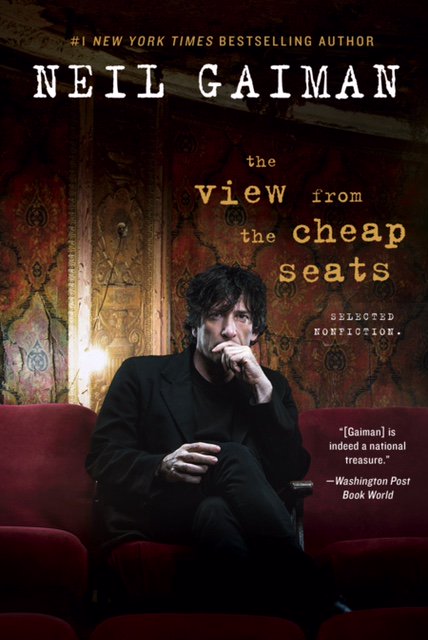
I learned to write by writing. I tended to do anything as long as it felt like an adventure, and to stop when it felt like work, which meant that life did not feel like work.
—Neil Gaiman, The View from the Cheap Seats, page 453
Like most parties in my life, I came to the Neil Gaiman party late, long after it was in full swing, and only after many invitations. His name kept being mentioned as someone I’d like or was talked about by people whose opinions I respected. Then Amazon’s algorithm somehow started recommending books of his to me as well. These emails went into the delete bin with perhaps a mental note of, “someday I’ll check him out,” until one of them had American Gods on sale for $2.99. I bought it because even if it was bad, it was only three bucks, and because that’s the one I heard most often about that would be my thing. (I had no idea Gaiman was most famous for being the one who did the Sandman series because I have absolutely no interest in comic books.)
I was just about to start my first NaNoWriMo project in 2020, and I set it aside as a treat to myself to read if I finished my 50,000 words in November. (Yes, I rewarded myself for writing a 50,000-word novel by allowing myself to read a 200,000-word one.) This delayed gratification ended up being quite the bit of luck because my novel shared an underlying premise of American Gods, but since I hadn’t read it (or anything about it; I always wait until I’m done reading a book or watching a movie to read about it because I want my opinions and experience to be my own, uninfluenced by foreknowledge, but if I like it, I will spend the rest of the day digging into the research), I can’t say I lifted anything from him. What I can say is that I’d found a kindred spirit, and that all those people who told me I’d like him were right all along.
My craft book reading party has long since ended. The streamers are strewn upon the floor, the empty bottles and glasses cluttering up the countertops, and the music has long since shifted from the loud and energetic party music to the quieter, subdued sort. My party started, like many other’s probably did, with Stephen King’s outstanding On Writing: A Memoir of the Craft. My first read of it was over twenty years ago, and although I can count on one hand the number of books I’ve read three times or more, it is on that hand. I would dip into another here or there over the years, but I didn’t start reading them seriously until 2020 when I was preparing to jump into my first NaNoWriMo, and I continued reading them for a couple of years afterward to make sense of the act of writing I’d just been caught committing.
I’ve generally stopped reading craft books for the sake of learning more about craft. I still dip into them here and there, but instead of being books I read Seriously (with a capital S), they’re light reading now; the sort of thing you read when you don’t want to read something taxing. Occasionally, I’ll be surprised about how there are, despite the thousands of craft books out there (writers love writing about writing, after all), still some with a fresh take on the subject. Chuck Palahniuk’s Consider This: Moments in My Writing Life After Which Everything Was Different was one of the best books I read in 2024.
It’s not that I don’t want to continue to get better; I think that a good word for something that isn’t growing is “dead.” It’s that at some point, once you’ve done enough writing that you’ve put enough sweat and energy and thought and craftsmanship into, you can and should reach a point where you can say, “This is who I am. This is how I work. This is how I do what I do and how I make what I make, not what someone else makes.” There has to come a point where your work stands on its own, when you kick the other chefs out of the kitchen and let your cooking taste what you make it.
I reached that point in early 2022, almost half a million words into the process of learning the craft. Although I still read an occasional straightforward craft book (this year, in addition to Palahniuk, I read Thomas Foster’s How to Read Literature Like a Professor and Francine Prose’s Reading Like a Writer), my focus has shifted toward books that deal with craft on a more abstract level, a level once-removed from the “how to” kind and more of a “this has been my life in my art” kind of level.

I’d love to hear from you!