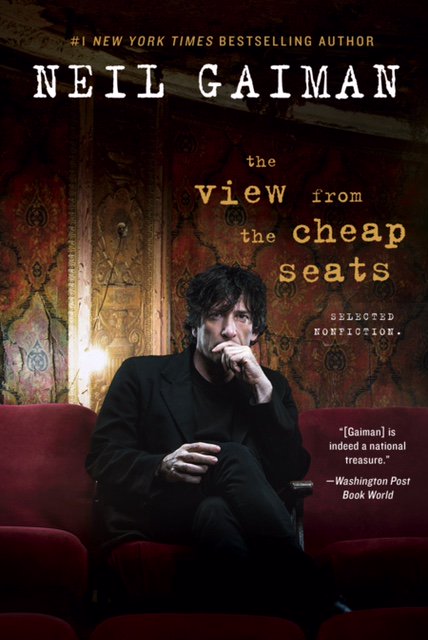
Neil Gaiman’s The View from the Cheap Seats: Selected Nonfiction is that kind of “stealth” craft book. With the exception of his early draft of the speech “Make Great Art” that would become a famous commencement address, there is little straightforward advice. There are no exercises, no prompts, no “do this this week and do this the next week” sort of items that are in the mass-market craft books. No pep talks (except “Make Great Art”), no bullet points and top 10 lists, no guarantees. There is nothing but an extremely intelligent, experienced, and successful creator who has selected pieces he finds interesting from what he’s created.
That is not to say that there is no advice. To the contrary, the book is filled with it. But instead of being separated out as nuggets or “how to,” the advice is couched in observations, both observations he’s made and the gestalt of being able to observe a master at work. For example, instead of grand tips on how to come up with an idea, he recounts his own process of how he came up with American Gods. Instead of laying out how to generate an idea, how to structure it into a story, how to come up with compelling characters, how to keep the reader engaged, and all of the other topics that might end up as entire chapters in a traditional craft book, he summed it up in barely a paragraph: he had just moved to the United States from England and wasn’t sure how he felt about it, so he wrote a book about it to discover his answer.
There are other pieces of more traditional, less-cryptic advice to be found, however:
As an artist, study other artists to see what they do, then look at life and see how it does something.
(page 250)
We all swipe when we start. We trace, we copy, we emulate. But the most important thing is to get to the place where you’re telling your own stories, painting your own pictures, doing the stuff that no one else could have done but you.
…And, as a writer, or as a storyteller, try to tell the stories that only you can tell. Try to tell the stories that you cannot help telling, the stories you would be telling yourself if you had no audience to listen. The ones that reveal a little too much about you to the world.
It’s the point I think of in writing as walking naked down the street: it has nothing to do with style, or with genre, it has to do with honesty. Honesty to yourself and to whatever you’re doing.
Don’t worry about trying to develop a style. Style is what you can’t help doing. If you write enough, or draw enough, you’ll have a style, whether you want it or not.
Don’t worry about whether you’re “commercial.” Tell your own stories, draw your own pictures. Let other people follow you. [What was huge five years ago tanked, and the oddball cult comics blew up.]
(p. 251)
One of the things I found most valuable was one of the things that, at first, I liked the least: the introductions. A large part of the book is reproductions of introductions he’s written for other authors. Initially, I didn’t read these with much care because many of them are for people I’ve never heard of. Many of them are people who are famous in their genre or field, but they’re not in a genre I care for.
Being able to identify why something is great is a critical part of being able to create something great, and writing introductions requires one to sum up those things that set a particular author’s work above the others. Gaiman, time and time again, does this. Sometimes it’s in amusing ways:
Our [Dave McKean and Neil] touchstone was something Terry Gilliam had once said about his wonderful film Time Bandits. He said he wanted to make something intelligent enough for children, but with enough action in it for adults. So did we.
(p. 207)
It might be seen as a problem for a writer who was considered a social satirist to have, a few pages into the first book in a bestselling series, destroyed the Earth. On the good side it sets you free to explore the vastness of the infinite. On the downside, it rather limits you as an observational humorist, when it comes to specifics, and while Douglas may not have been a novelist, he was definitely an observational humorist.
(p. 370)
Sometimes it’s in a gorgeous, eloquent way, such as in the following three:
Good malt whisky tastes of one thing; a great malt whisky tastes of many things. It plays a chromatic scale of flavor in your mouth, leaving you with an odd sequence of aftertastes, and after the liquid has gone from your tongue you find yourself reminded of at first honey, then woodsmoke, bitter chocolate and of the barren salt pastures at the edge of the sea. Fritz Leiber’s short stories do the same thing a fine whisky does. They leave aftertastes in memory, they leave an emotional residue and resonance that remains long after the final page has been turned. Like the stage manager in “Four Ghosts in Hamlet,” we feel that Leiber spent a lifetime observing, and he was adept at turning the straw of memory into the bricks of imagination and of story. He demanded a great deal of his readers—you need to pay attention, you need to care—and he gave a great deal in return, for those of us that did.
(pp. 167-68)
[Jack Kirby] would take ideas and notions and he would build on them. He would reinvent, reimagine, create. And more and more he built things from whole cloth that nobody had seen before. Characters and worlds and universes, giant alien machines and civilizations. Even when he was given someone else’s idea he would build it into something unbelievable and new, like a man who was asked to repair a vacuum cleaner, but instead built it into a functioning jet-pack.
(The readers loved this. Posterity loved this. At the time, I think, the publishers simply pined for their vacuum cleaners.)
Page after page, idea after idea. The most important thing was the work, and the work never stopped.
(p. 275)
It is not that the Father Brown stories lack color. Chesterton was, after all, an artist, and begins almost every story by painting in light. “The evening daylight in the streets was large and luminous, opalescent and empty” (“The Man in the Passage”); “It was one of those chilly and empty afternoons in the early winter, when the daylight is silver rather than gold, and pewter rather than silver” (“The God of the Gongs”); “The sky was a Prussian an blue as Potsdam could require, but it was yet more like that lavish and glowing use of the color which a child extracts from a shilling paint box” (The Fairy Tale of Father Brown”)—three examples picked at random from The Wisdom of Father Brown, each occurring in the first paragraph.
(p. 344)
When discussing the process of creating the movie Mirrormask, he has timeless advice that applies to life in general, and creativity in particular—the only way to learn something is to do it:
I like film. I am not very good at writing for film yet, which is what keeps me interested in it. Most of all I like the astonishing process–it’s hard to get near a film set without remembering Orson Welles’s description of a film studio as “the biggest electric train set any boy could ever have.”
(p. 223)
And then he proceeds to look at the field he learned the trade in with an eye and depth not often given to comic books:
Still, the “unlimited special effects” nonsense hides a truth or two. Ink is cheaper than film. Film, especially big-budget film, often needs to compromise in order to be liked by the biggest possible number of people around the world. A comic tends to be a small enough, personal enough, medium that a creator can just make art, tell stories, and see if anyone wants to read them. Not having to be liked is enormously liberating. The comic is, joyfully, a bastard medium that has borrowed its vocabulary and ideas from literature, science fiction, poetry, fine art, diaries, film and illustration. It would be nice to think that comics, and those of us who come from a comics background, bring something special to film. An insouciance, perhaps, or a willingness to do our learning and experimenting in public.
(p. 224)
And then there are the general observations on the craft and/or the process:
The magic and the danger of fiction is this: it allows us to see through other eyes. It takes us to places we have never been, allows us to care about, worry about, laugh with, cry for, people who do not, outside of the story, exist.
There are people who think that things that happen in fiction do not really happen. These people are wrong.
(p. 415)
Those of us who write fantasies for a living know that we are doing it best when we tell the truth.
(p. 421)
Once upon a time, back when animals spoke and rivers sang and every quest was worth going on, back when dragons still roared and maidens were beautiful and an honest young man with a good heart and a great deal of luck could always wind up with a princess and half the kingdom—back then, fairy tales were for adults.
(p. 423)
[Will Eisner] told me about a film he had seen once, in which a jazz musician kept playing because he was still in search of the Note. That it was out there somewhere, and he kept going to reach it. And that was why Will kept going: in the hopes that he’d one day do something that satisfied him. He was still looking for the Note…
(p. 293)
[W]hen you start off, you have to deal with problems of failure. You need to be thick skinned, to learn that not every project will survive. A freelance life, a life in the arts, is sometimes like putting messages in bottles, on a desert island, and hoping that someone will find one of your bottles and open it and read it, and put something in a bottle that will wash its way back to you: appreciation, or a commission, or money, or love. And you have to accept that you may put out a hundred things for every bottle that winds up coming back.
(p. 453)
Most of the work I’ve done that’s been highly regarded has happened in places where, when I was working on it, I tended to suspect that it would go one of two ways—either I was doing something cool that, if I was lucky, people would talk about for some time, or I was doing something that people would have a particularly good laugh about, in the places where they gather to discuss the embarrassing mistakes of those who went before them.
Be proud of your mistakes. Well, proud may not be exactly the right word, but respect them, treasure them, be kind to them, learn from them.
And, more than that, and more important than that, make them.
(p. 304)
At 522 pages, this is not a light beach read, nor is it a quick-fix “Write a Novel in 90 Days!” kind of craft book. (Then again, it’s still shorter than American Gods, the masterpiece that first brought Gaiman to my attention.) It’s not intended to be a craft book, but through sheer volume and clear intellect, you can’t help but become a better writer by watching Gaiman get to the heart of what makes good “Good.”
If you take nothing from this book but the early text to his speech “Make Great Art,” you’ll have invested all of the hours you put into this book wisely.

I’d love to hear from you!