Maps aren’t for places we’ve been, they’re for places we haven’t been yet. Once we’ve been there, we don’t need a map anymore.
World geography was one of my favorite subjects in high school. Most people disliked it or worse because to them it was nothing more than memorizing names and facts. I loved it because I’d always wonder what it must be like to live there, whether it was Norway, Romania, Bolivia, or (yes, it’s a real place) Timbuktu. Maps weren’t dull, static pieces of paper to me: they were travel permits.
But those were all maps of places that actually exist. Today, I’ve got three fictional maps to let your mind wander around.

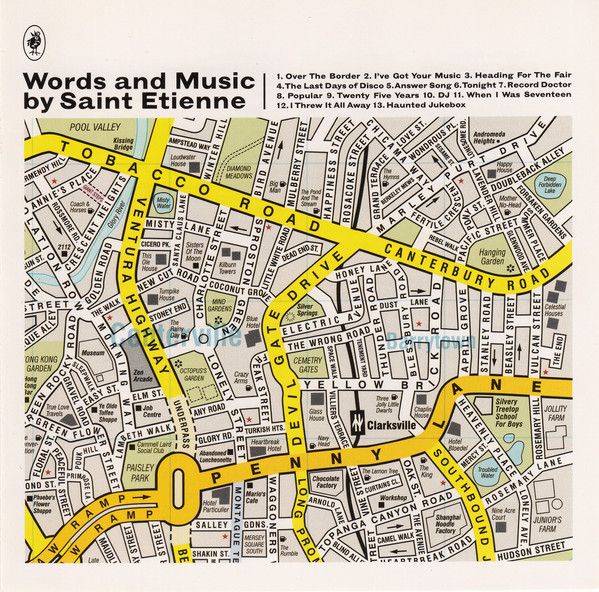
The first one is another album cover by Saint Etienne. I’m not going to go into nearly as much detail on this one as I did with the cover of Tales from Turnpike House, which is brilliant in its own different way. Words and Music has one of the best tracks in their entire discography on it, “I’ve Got Your Music,” and this excellent cover to go with it.
The street names on this map are obviously not real: Penny Lane is in there, as is Yellow Brick Road, and even The Wrong Road, but the details go even deeper. There’s a little lake named “Troubled Water,” and there’s a road that must have a bridge over it. And if you look closely enough, the Chocolate Factory is even in there.
This is where craft meets imagination. You can even buy maps like this for songs, films, and other things (including “Jack Torrance, Writer” business cards) from the same place that created this cover. I make absolutely no money if you do, so I’m recommending you check it out because they have such a creative selection. (The only affiliate program I’m with is Amazon, and all that money goes to charity.)

One Hundred Years of Solitude by Gabriel García Márquez is a masterpiece, but an imposing one. Even if you haven’t read the book, you can appreciate this map of the imaginary place of Macondo for what it is: a creation entirely out of one writer’s mind.

This last map comes from The Phantom Tollbooth, a children’s book by Norton Juster. The map isn’t really necessary to understand the book; it’s a whimsical but beautiful addition. The whimsicality is the important part here: let your mind wander along these paths of fiction and you might end up inspired to create some of your own.
Good luck and have fun!

I’d love to hear from you!