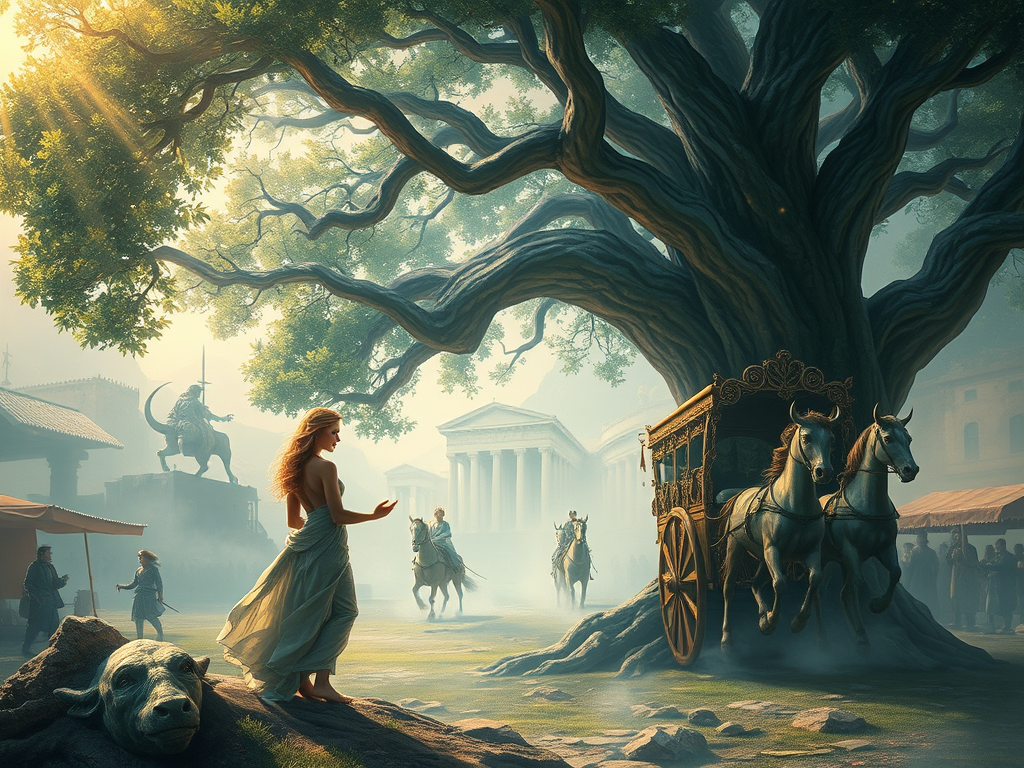
[B]ecause of the way that myth takes it for granted that miracles are always happening, the waking life of a mythically inspired people – the ancient Greeks, for instance – more closely resembles a dream than it does the waking world of a scientifically disenchanted thinker. When every tree can suddenly speak as a nymph, when a god in the shape of a bull can drag away maidens, when even the goddess Athena herself is suddenly seen in the company of Peisistratus driving through the market place of Athens with a beautiful team of horses… then, as in a dream, anything is possible at each moment, and all of nature swarms around man as if it were nothing but a masquerade of the gods, who were merely amusing themselves by deceiving men in all these shapes.
But man has an invincible inclination to allow himself to be deceived and is, as it were, enchanted with happiness when the rhapsodist tells him epic fables as if they were true, or when the actor in the theater acts more royally than any real king. So long as it is able to deceive without injuring, that master of deception, the intellect, is free; it is released from its former slavery and celebrates its Saturnalia.
—Friedrich Wilhelm Nietzsche, from “On Truth and Lies in a Moral Sense”
Although the name This Beautiful Sentence would imply only one sentence (or maybe a couple at most), occasionally I come across something that is so well-constructed that it can’t be plucked out on its own. The beauty of the idea here is dependent on the beauty of its sentences, and they all depend on each other like a diamond relies on all of its facets to sparkle.
Nietzsche here encapsulates the wonder of literature done well, not as fantasy (trees as nymphs and gods as bulls), but in the conclusion of the first paragraph. Good writing is metaphorically “nothing but a masquerade of the gods, who were merely amusing themselves.”
Many of Nietzsche’s ideas are still with us today, some so deeply rooted in critical and writing theory that we no longer even think of him when we talk about the conflict of the Apollonian and the Dionysian; it’s as if the concept had always existed. Another of his ideas that lives on over a century after he died is the Eternal Recurrence. This time it’s in (of all places) one of the best Rush songs of all time, “Headlong Flight.” Neil Peart wasn’t your typical rock star: he was introverted and extremely well read, and this entire song is about Nietzsche without ever mentioning him by name:
Last week: Goethe gets blue.
Next week: Freud hears voices.
See the index for what’s been posted and what’s to come.




I’d love to hear from you!