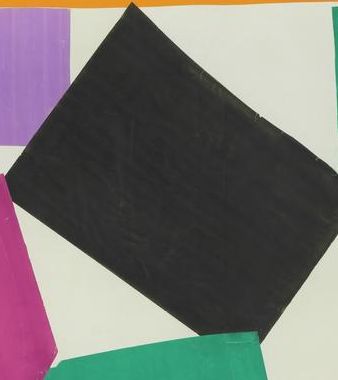
Last week, we examined color in Matisse’s L’escargot. This week, let’s look closely at just one part of the same work.

Do you see how the black rectangle doesn’t just sit there and exist on its own? It actively interacts with its surroundings to create two triangles that flank it on either side. They give it wings while also giving it outline. Even though they’re “empty space,” they are active participants in the work as a whole.
I used this same technique when creating the artwork I discussed recently. Most of the red marks are put into space that is deliberately left uncolored or given only a few other flourishes of blue or green in order to make it stand out even more. I did this to give the artwork a sense of movement and emphasize the flow of energy from the figure on the left to the one on the right and how it branches off into two streams, one going to the figure on the right’s head and the other to her lower regions:

This principle applies to your own writing. You don’t have to say everything that needs to be said. Trust your reader to understand and they’ll appreciate you not patronizing them. They’ll enjoy it more because you make them a more active participant in the reading process. You like being trusted, so why do you think your reader wouldn’t?
Here’s a micro-example from a work-in-progress of mine:
“You and I have always connected. We’ve always looked out for each other when everyone else was too busy to. And, you know, it seems like you’d understand this more than anyone else.”
“What’s that supposed to mean?”
“You sound mad.”
“No, no, no. Not at all. Just surprised.”
I’ve said several times that I write scenes in walls of bare dialogue. It’s effective and efficient, and I’ve almost never been asked for more dialogue tags. A more clumsy writer may have handled it this way:
My brother touched my shoulder tenderly. “You and I have always connected. We’ve always looked out for each other when everyone else was too busy to. And, you know, it seems like you’d understand this more than anyone else.”
I pulled back, afraid that my secret was out. I wrung my hands and said, “What’s that supposed to mean?”
He stepped back. “You sound mad.”
I shook my head. “No, no, no. Not at all." I shrugged. "Just surprised.”
Are any of those small movements necessary? I think that not only are they unnecessary, explaining to the reader how a line is supposed to be read (which is the purpose these additions serve here) interferes with the reading itself. With them there, the reader isn’t allowed to provide their own emotion. No one is going to read, “What’s that supposed to mean” with a smile unless you tell them to. Let Matisse’s white triangles form themselves from the black rectangle you put there. You give the reader the gift, then let them unwrap it themselves.
That example was a very zoomed-in version of the idea of listening to silence. What’s around your words is also around your paragraphs and your pages and your whole work. What’s not said is as important as what is said, as anyone who has had a bad fight with a significant other can attest.
This technique is a very tricky one. If you’re one of those who have to describe everything, don’t feel bad: the second version reads like 90% of books on the market, including some very good works. In fact, it’s so hard to get just right that it can backfire sometimes. Probably its most spectacular failure was with Nabokov’s Lolita in which Nabokov relied too much on the audience to read the white space and understand that the book was actually about Dolores’s suffering and the tragedy of being her, not Humbert and his predation. Nabokov was a poet and an architect at the same time, but even the best-designed bridges fail when structure and beauty aren’t aligned. Even Stanley Kubrick, one of the greatest geniuses of all time, got it completely wrong with his film version. It’s hard to blame him because everyone got that book wrong, but it’s an impressive achievement that Nabokov’s technique caused someone like Kubrick who obviously understands the process of moving something from novel to screen (despite what Stephen King says, did a better job filming The Shining than King did writing it, and I say that as a King fan) to read too little of what wasn’t there.
Despite that, I still recommend you try letting silence speak. Since it’s hard to get right, the way I’d recommend going about it is to write everything that is there, then take out parts. If, as they so often do, the point is even clearer when they’re gone, then they’re the white space you need. This is one of the areas where writing becomes an art (and why AI often seems to drone on like a kid who waited until 11:00 the night before to write their term paper and then hammers out a 3,000-word C-). You’ll be surprised how much color a lot of white can add.
Good luck, have fun, and happy Valentine’s Day!



I'd love to hear from you!