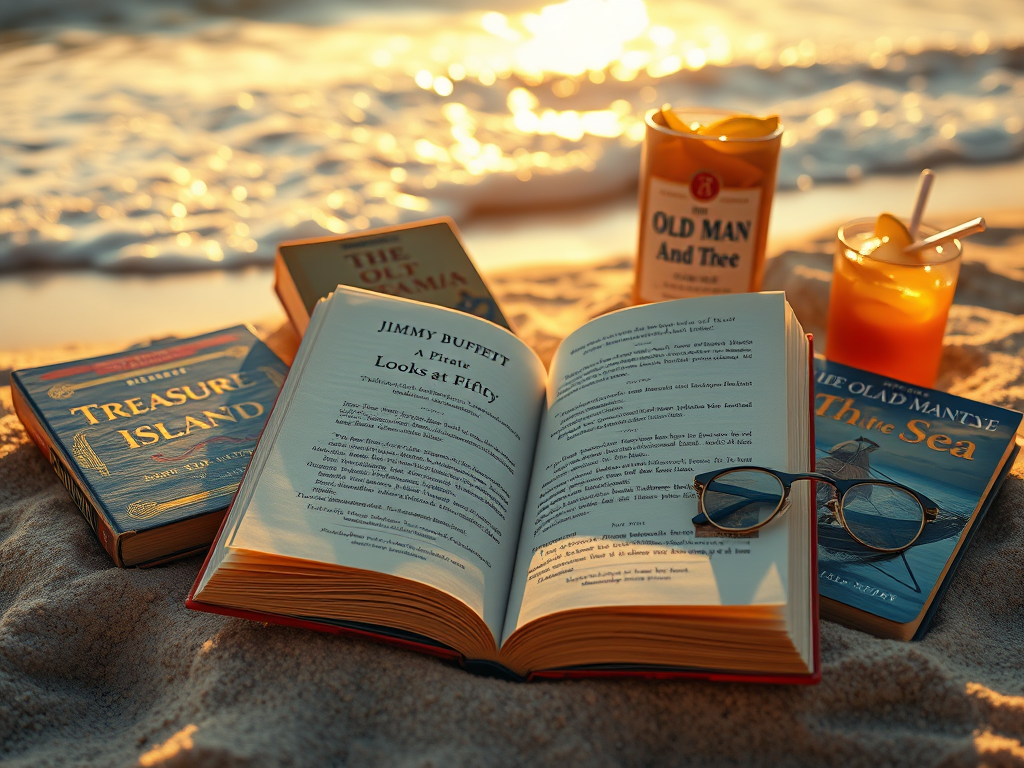
I like to read books when I’m in a place that has a connection to them. For example, I read Charles Lindbergh’s The Spirit of St. Louis when I was in St. Louis for a while back in 2016. A few years ago, while I was in Minnesota for a few months, I read Garrison Keillor (and even went to Holdingford, which is one of the places that Lake Wobegon is vaguely based upon). Now I’m reading Jimmy Buffett’s A Pirate Looks at Fifty. I’ll leave it to you to figure out why.
Only a couple of weeks after I wrote, “if I was going into space for a year and could only bring one book, it would be Pablo Neruda’s collected poems,” I came across this page in Buffett’s book:
For those who might be interested, besides Following the Equator, here are the twelve other books I would take to a desert island:
The Adventures of Huckleberry Finn by Mark Twain
Treasure Island by Robert Louis Stevenson
Don’t Stop the Carnival by Herman Wouk
Winds from the Carolinas by Robert Wilder
One Writer’s Beginnings by Eudora Welty
The Old Man and the Sea by Ernest Hemingway
A Gift from the Sea by Anne Morrow Lindbergh
The Fables of La Fontaine by Jean de la Fontaine
West with the Night by Beryl Markham
A Collection of Poems by Pablo Neruda
The Road Less Traveled by M. Scott Peck
No One Writes to the Colonel and Other Stories by Gabriel García Márquez
This is an excellent collection of books even if you’re not a pirate. First (obviously), I think it’s great that both Buffett and I would both spend a long time abandoned with Neruda. (And García Márquez; although I haven’t read No One Writes to the Colonel, I’ve read A Hundred Years of Solitude in both English and Spanish and it’s still one of my favorite books.)
He has two Twain works on the list (Huck Finn and Following the Equator), and about a decade ago I spent almost a year reading every novel or short story Twain has ever written. I consider that to be time well spent. I did the same with Hemingway a couple of years later, but I would have picked The Sun Also Rises or For Whom the Bell Tolls instead of The Old Man and the Sea, but they lack the nautical theme.
Although it’s been almost thirty years since I read Treasure Island, I liked it so much that in one of my books, the main character mentions she’s reading it when she’s twelve. It’s on my bookshelf, waiting to be read again someday. It’s the book that made pirates cool, so it definitely has a place in a book called A Pirate Looks at Fifty.
I have an illustrated version of Markham’s West with the Night, and it is a book that should be on every pilot’s, poet’s, or pilot/poet’s bookshelf along with St. Exupery, Ernest Gann’s Fate is the Hunter, and Bob Buck’s North Star Over my Shoulder. All four of these authors manage to pull off the colossal task of capturing the soul and the spirit of flying. Anne Morrow Lindbergh is probably one of the reasons The Spirit of St. Louis was as beautifully written as it was, even if technically it was her husband Charles Lindbergh’s book.
One of the picks I found most interesting was The Fables of La Fontaine. Fables and fairy tales bring us back to the purest form of storytelling. I haven’t read La Fontaine specifically, but that needs to be followed with a yet. I’ve read Grimm and Aesop and other fables, plus multiple versions of the Arthurian legends, which have a strong element of fairy tale in them. (Plus my acting debut and finale was in a grade school version of Cinderella.) So it’s a genre I like and— maybe ironically, maybe not—the older I get the more I like fables and fairy tales.
Or it may not have to do with age but instead it may be that the better I get at writing, the more I admire their simplicity and effectiveness. The canonical fables and fairy tales were written long before the days of explosions, special effects, and billion-dollar budgets. They had to rely on the strength of their stories, not the box office power of an ensemble of stars. This may be why the genre is enjoying a resurgence: in the muck of CGI and incessant superhero spawn, Hollywood, Disney, and the streaming services that create their own content have forgotten that they are in the business of storytelling. Four hundred years from now, people won’t still be watching The Avengers or know (or even care) what the hell DCU means, but we still read stories from La Fontaine today. Not bad for something with an FX budget of zero.
Any of the books on Buffett’s list are hours of your life that will be well spent. If I ever do get around to creating a list of my twelve indispensable books, it would look a lot like this one but different. (For example, mine would have The Princess Bride on it and Carl Jung in place of M. Scott Peck.) What book do you think should be on the list? Let me know in the comments.


I’d love to hear from you!