I recently finished PSYC E-1704, Creativity Research: Eccentrics, Geniuses, and Harvard Students. I have taken a lot of college classes and this one is definitely in my top 10 for ones I’ve learned the most from. Highly recommended as long as you can keep up with an insane amount of reading, several papers, and a large final project.
The final project is a creative work. Sounds easy enough, right? The thing is, it has to be a work in a field you’re not already good at. The point is to stretch oneself and to gain a better insight into one’s creativity by taking out the element of automaticity.
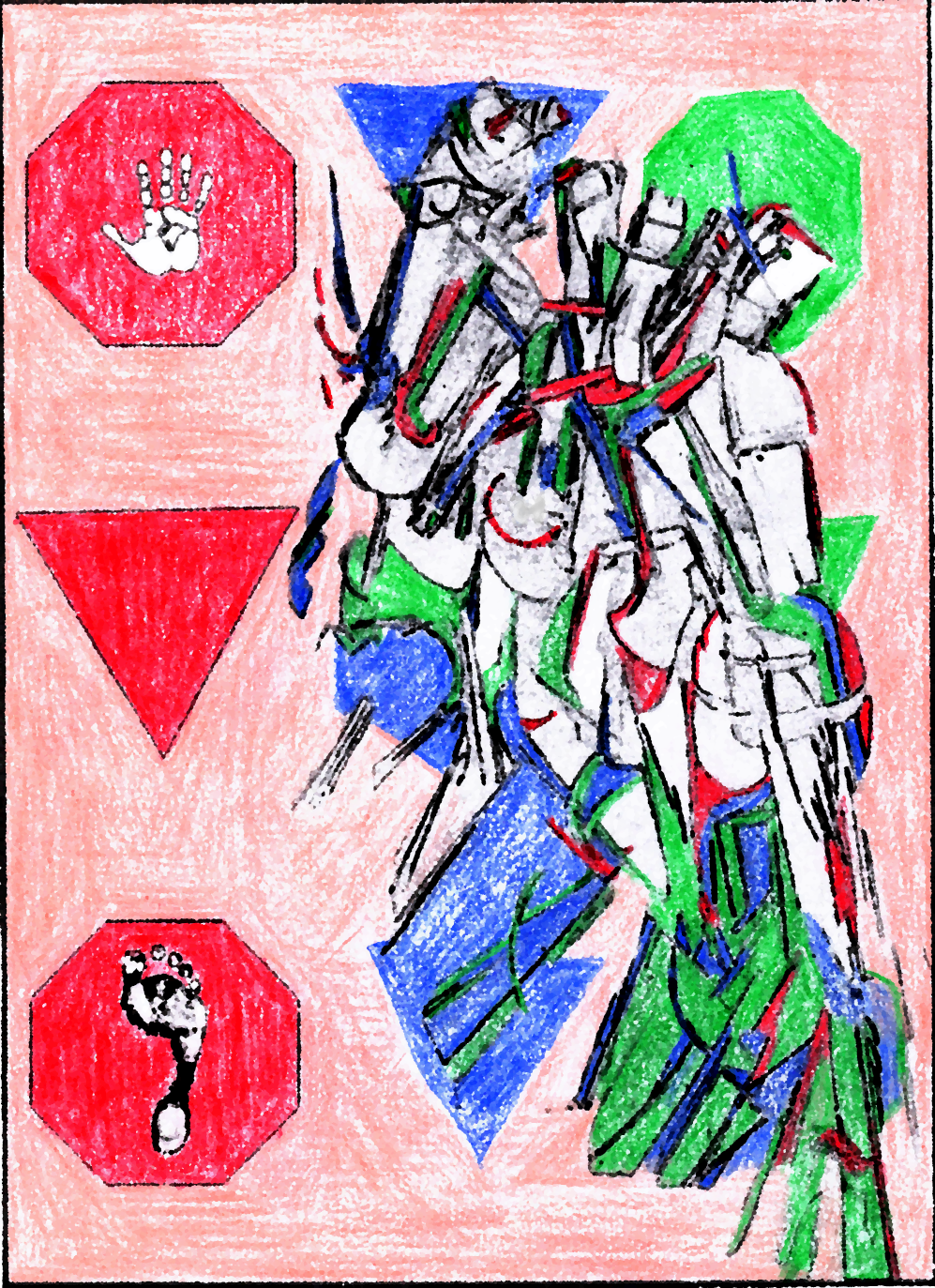
That means as a writer, I couldn’t write something. But I happen to have a complex painting that appears in two important moments in the novel I’m currently working on. Attempting to create that painting for real would be a super-stretch goal for someone like me who can paint scenes in words but not in, well, paint.
Failing to create something perfect doesn’t endanger your grade because it’s documenting the process that counts. And that’s good because I definitely didn’t create on paper what I had in my head, but I did keep track of the steps I took to come up with what came out.

The painting in the novel is intentionally complex: it’s supposed to be the work of an intensely-talented precocious high school student. It combines a Twister board, Andy Warhol’s Marilyn Diptych and Marcel Duchamp’s Nude Descending a Staircase, uses the Stroop effect to play on the semiotics of stop and yield signs (yes, that’s a multilayered metaphor in the novel), incorporates an unconventional method of paint application, and even its name (Ceremony of Innocence) comes from a poem by Yeats. In other words, it would take a professional artist to get this correct, not someone like me whose entire painting experience is several evenings at one of those “paint while you drink” studios.
Did I pull it off? Nope. The final product is related to the envisaged painting as the weird cousin no one talks about is related to the family’s star daughter. (In literary terms, it’s the Bertha Rochester of Jane Eyre compared to Jane herself.) Am I happy with it? Absolutely. Proud of it, maybe? Definitely.
Why would I be happy and proud? Because as short of the mark as it is, it’s still way better than I thought I could do. In fact, I even learned a bit about how I write while trying to paint. If you take a look at the red marks in the right two-thirds, you can see the energy flow from left to right the way motifs and leitmotifs flow in a well-constructed book. The uncolored parts aren’t accidental: they’re analogous to how the things left unsaid in a book make the things that are there stand out even more clearly.
Don’t be afraid to experiment with something you’re not good at. It doesn’t have to be something as drastic as a whole different field. If you’re someone who doesn’t use a lot of description (like me), try writing something elaborately descriptive. Or if you have the opposite problem, try writing a scene with almost no description. You’d be surprised how far minimalism can carry you, and it’s certainly a very attainable goal. (After all, I do it all the time whether I try to or not. Think of all the images the last line of that scene brings to mind in only two words.) What’s important is that you’re trying something you wouldn’t, and when you do, you might just get better at what you already like to do.
Practicing an art, no matter how well or badly, is a way to make your soul grow, for heaven’s sake. Sing in the shower. Dance to the radio. Tell stories. Write a poem to a friend, even a lousy poem. Do it as well as you possibly can. You will get an enormous reward. You will have created something.
—Kurt Vonnegut

I’d love to hear from you!