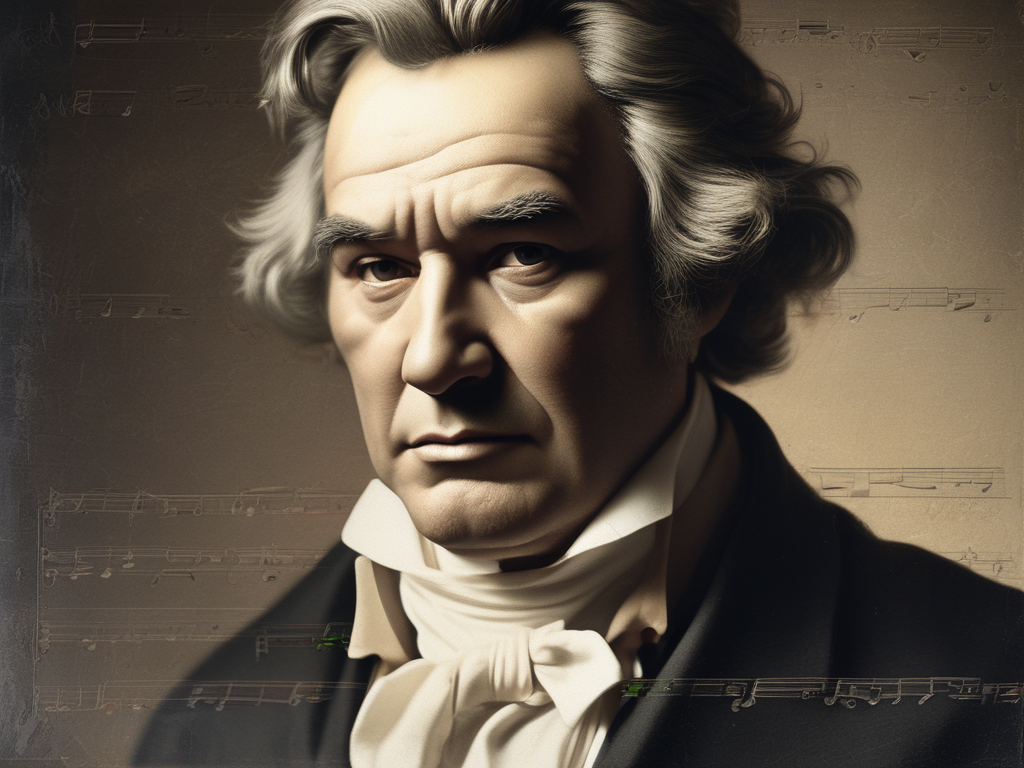
This is the last Monday post before I shift into October’s NaNoWriMo prep month marathon. If you’re planning on trying to tackle the insane idea of writing a novel in a month, you don’t need to justify it to anyone, even yourself. Beethoven speaks from beyond the grave at an exhibit inside the Minneapolis-Saint Paul airport and gives us the only reason you need:

I have never thought of writing for reputation and honor. What I have in my heart must out; that is the reason why I compose.
—Ludwig van Beethoven
If you’re not planning on doing NaNoWriMo, Beethoven’s words are also solace if you, like most writers, are dealing with rejection. What’s in your heart has value to someone. That someone may only be you right now, but someday you’ll find a kindred spirit. Then another. Then another. Your audience of one will become an audience of many, even if it takes years.
In 1802, at the age of only 32, thinking that what was causing his deafness would progress to causing his death, Beethoven was writing his will. In it, he says:
….you do not know the secret causes of my seeming, from childhood my heart and mind were disposed to the gentle feelings of good will, I was even ever eager to accomplish great deeds, but reflect now that for six years I have been a hopeless case, aggravated by senseless physicians, cheated year after year in the hope of improvement, finally compelled to face the prospect of a lasting malady (whose cure will take years or, perhaps, be impossible), born with an ardent and lively temperament, even susceptible to the diversions of society, I was compelled early to isolate myself, to live in loneliness….
—Ludwig van Beethoven, Heiligenstadt Testament
What despair. He’d already had an extraordinary life, having just composed what is probably the single most famous piano piece ever (the “Moonlight Sonata”), but less than a year later he thought it was over. He thought he was finished and that he’d never create again. He was considering suicide. And yet, here’s a very-abridged list of things he created after 1802:
- Symphony No. 3 (“Eroica”)
- Symphony No. 5 (the entire world knows its da da da DUM)
- Symphony No. 9 (the one with “Ode to Joy” in it; if you stuck around for the credits of the movie Die Hard, you’ve heard it)
- his only full violin concerto, which itself was a failure at its premiere and is now one of the most famous and most-performed in the world. I’ll occasionally write with classical music playing, but this is one of those that I can’t do that with because its beauty keeps pulling my brain toward it instead of what I’m writing.
- “Für Elise,” a sonata which is almost as famous as the “Moonlight Sonata.” You absolutely know it, even if you don’t know its name.
This is by no means a full list of what he created after he was convinced his life was over. His wasn’t and yours isn’t.
I'd love to hear from you!